
Severe scissor bite is a challenging orthodontic condition, particularly when it involves posterior molars. Conventional treatment approaches may require complex biomechanics or surgical intervention. With the advancement of digital dentistry, clinicians are increasingly integrating digital workflows to improve treatment planning and appliance fabrication.
A case report published in the journal Dental Hypotheses demonstrates how a digital orthodontic workflow can be used to treat severe scissor bite in second molars. The treatment combined guided miniscrew placement with clear aligner therapy to achieve controlled tooth movement.
What Is a Scissor Bite?
Scissor bite is a type of posterior crossbite in which the upper molars are positioned excessively toward the buccal side relative to the lower molars. This condition may lead to:
- difficulty in chewing
- abnormal occlusal contact
- uneven tooth wear
- long-term functional problems
When second molars are involved, treatment becomes more complex due to the limited accessibility and difficulty in controlling tooth movement.

Digital Workflow in Orthodontic Treatment
In the reported case, clinicians adopted a digital workflow to improve treatment precision and predictability.
The workflow included:
1. Digital diagnosis
Cone-beam computed tomography (CBCT) and digital scans were used to evaluate the patient’s dental anatomy.
2. Surgical guide for miniscrew placement
A surgical guide was used to improve miniscrew placement accuracy in this case, particularly under challenging anatomical conditions.
3. Miniscrew anchorage
Temporary skeletal anchorage devices (TSADs) were placed to provide stable anchorage for molar movement.
4. Clear aligner therapy
Clear aligners were used to gradually reposition the affected teeth following miniscrew placement.

The Role of Dental 3D Printing
Dental 3D printing plays an important role in digital orthodontic workflows, particularly for producing dental models used in aligner fabrication.
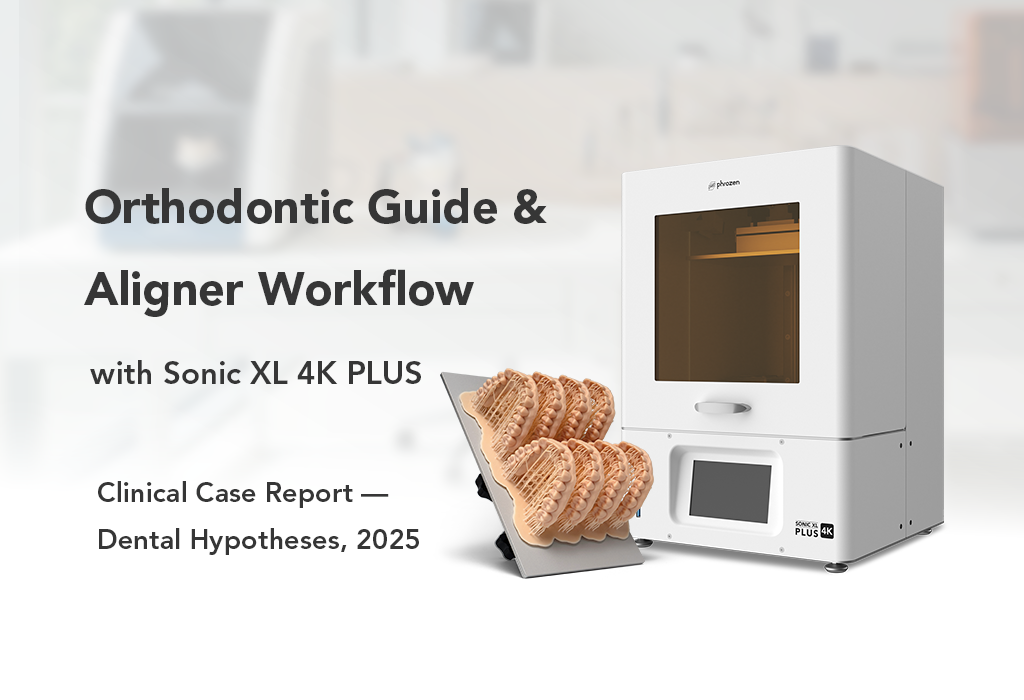
In this case, dental models were produced using the Phrozen Sonic XL 4K Plus dental 3D printer, enabling in-house production of aligner models as part of the digital treatment workflow.
In-house 3D printing can provide several advantages:
- faster appliance production
- improved workflow efficiency
- greater flexibility in treatment adjustments

Clinical Outcome
By combining guided miniscrew placement with clear aligner therapy, the clinicians successfully corrected the severe scissor bite and restored functional occlusion.
This case highlights how digital technologies—including surgical guides, digital planning, and dental 3D printing—can support complex orthodontic treatments and improve workflow efficiency.
Reference
Viet H. et al.
Correcting Severe Scissor Bites in Second Molars with a Digital Surgical Guide for Miniscrew Placement and In-House Directly Printed Clear Aligners: A Case Report.
Dental Hypotheses, 2025.
Full article
*Some images in this article are for illustrative purposes only.
